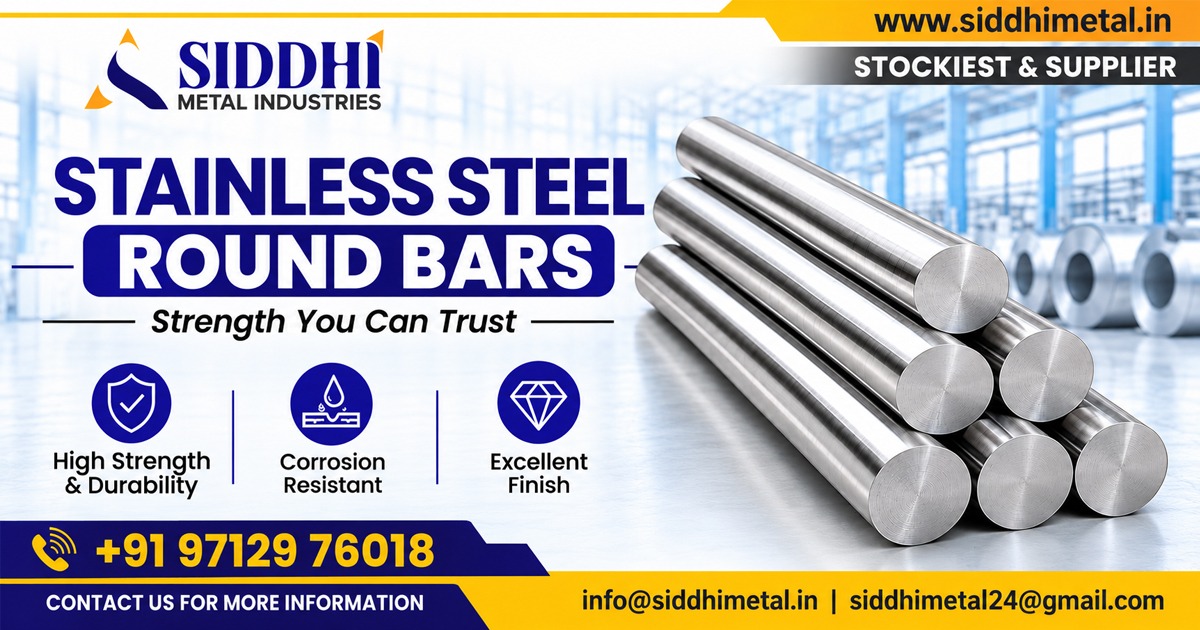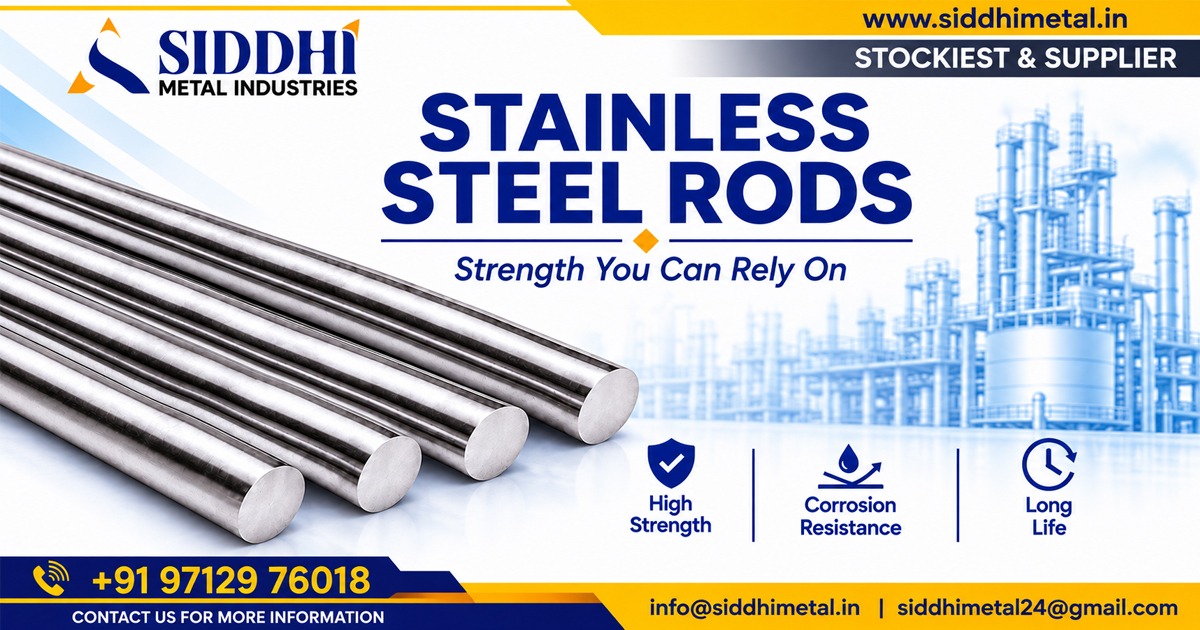
Industries in Kerala require stainless steel rods with suitable strength, corrosion resistance, and dimensional accuracy. Siddhi Metal Industries supports buyers with product sourcing and manufacturing support from Ahmedabad, Gujarat, India, for varied industrial requirements.
Understanding Stainless Steel Rods for Industrial Fabrication
Their combination of mechanical strength and corrosion resistance makes them useful in industrial environments where ordinary steel may require more frequent protection.
For businesses looking for a Stainless Steel Rods Supplier In Kerala, selecting the correct material grade is important because operating conditions differ across industries.
Common industrial requirements include:
- Machinery manufacturing: Rods are machined into shafts, pins, rollers, and connecting components.
- Food processing: Stainless steel material is selected for equipment parts that require suitable corrosion resistance and cleanability.
- Chemical processing: Appropriate grades are considered for components exposed to process chemicals.
- Construction and fabrication: Solid rods support different structural and engineering requirements.
- Automotive engineering: Stainless steel rods are used in selected mechanical and precision components.
The correct grade and surface condition should always match the intended application rather than relying on general material properties.
Five Selection Decisions That Influence Rod Performance
Before purchasing stainless steel rods, procurement teams should prepare a clear material specification. This reduces the possibility of receiving material that does not match the machining or fabrication requirement.
1. Select the appropriate stainless steel grade
Different grades offer different corrosion resistance, mechanical properties, and fabrication characteristics.
| Grade | General characteristics |
| SS 304 | General-purpose corrosion resistance and fabrication suitability |
| SS 304L | Lower carbon variant of 304 |
| SS 316 | Improved resistance in many chloride-containing environments |
| SS 316L | Lower carbon variant of 316 |
| SS 321 | Titanium-stabilized stainless steel |
| SS 347 | Niobium-stabilized stainless steel |
2. Confirm the diameter and length
The rod dimensions must match the component drawing or machining plan.
Check:
- Required diameter in millimetres.
- Standard or cut length.
- Dimensional tolerance.
- Straightness requirements.
- Machining allowance.
3. Choose the correct surface finish
Common surface conditions include bright, polished, and black finishes. A polished finish may be suitable where appearance or surface condition matters, while other finishes may be appropriate for machining applications.
4. Consider the manufacturing process
Cold-drawn, hot-finished, and ground products can have different dimensional and surface characteristics. Select the condition according to the required precision and downstream operation.
5. Evaluate the operating environment
Consider moisture, chemicals, temperature, cleaning procedures, and exposure to corrosive substances. These factors influence material selection and expected service performance.
From Material Identification to Finished Component: How Rods Are Used
Stainless steel rods generally pass through several stages before becoming finished industrial components.
Step 1: Material identification
The required grade, diameter, length, and material condition are identified according to the engineering drawing or purchase specification.
Step 2: Cutting and preparation
The selected rod is cut into suitable lengths. The cutting method depends on material dimensions and the requirements of the next manufacturing operation.
Step 3: Machining or fabrication
Depending on the application, the material may undergo turning, drilling, milling, grinding, threading, or other fabrication processes.
Step 4: Finishing and inspection
The finished component is checked for dimensional accuracy, surface condition, and conformity with the required drawing.
Step 5: Assembly and installation
After inspection, the component is incorporated into the machine, equipment, or industrial assembly.
Correct material identification at the beginning helps reduce machining problems, dimensional mismatches, and unnecessary material wastage.
Purchase Inspection: What Procurement Teams Should Verify
A technically suitable product should also meet the buyer’s documentation and inspection requirements.
Before confirming an order with a supplier, consider the following checks:
- Grade identification: Confirm that the supplied material matches the ordered stainless steel grade.
- Dimensional verification: Check diameter, length, tolerance, and straightness.
- Surface inspection: Look for visible cracks, deep scratches, corrosion marks, or other surface irregularities.
- Material documentation: Request a material test certificate when required by the purchase specification.
- Quantity verification: Confirm the number of pieces or total weight against the purchase order.
For precision machining, dimensional tolerances and surface conditions deserve particular attention. A rod that meets the nominal diameter but does not satisfy the required tolerance may create problems during machining.
Storage, Handling and Maintenance of Stainless Steel Rod Stock
Although stainless steel offers corrosion resistance, improper storage and handling can affect its surface condition.
Industrial buyers and fabrication teams should follow these practices:
- Store rods in a dry, organised area.
- Keep different grades separated to prevent material mix-ups.
- Avoid direct contact with carbon steel dust and contaminated tools.
- Use suitable lifting equipment for heavy or long material.
- Protect polished surfaces from scratches during transportation.
- Inspect stored material periodically for moisture-related contamination.
- Use appropriate cleaning methods if surface contamination occurs.
Common handling problem: Surface rust-like marks may develop due to contamination from external iron particles.
SERVICES
- Stainless steel rod grade and dimensional requirement consultation.
- Material identification and product selection assistance.
- Supply coordination for industrial fabrication and machining requirements.
- Technical assistance for product documentation and order planning.
LOCATION
Kerala has diverse industrial requirements across engineering, food processing, marine-related activities, construction, fabrication, and manufacturing sectors. Businesses sourcing stainless steel rods can evaluate material requirements according to their individual operating environments in Kochi, Ernakulam, Thiruvananthapuram, Kozhikode, Thrissur, Kollam, Kannur, Palakkad, Kottayam, Alappuzha, Malappuram, Kasaragod, Pathanamthitta, Idukki, Wayanad, Muvattupuzha, Perumbavoor, Angamaly, Kalamassery, Eloor, Aluva, Cherthala, Palarivattom and Thalassery.
How Siddhi Metal Industries Supports Industrial Material Requirements
Choosing a metal supplier involves more than comparing prices. Buyers need clear product specifications, material identification, supply coordination, and communication throughout the purchasing process.
Siddhi Metal Industries is involved in manufacturing and stocking stainless steel and mild steel industrial products. Its product portfolio includes stainless steel rods, round bars, sheets, pipes, tubes, flanges, fittings, valves, and fasteners.
For buyers in Kerala, the company can help coordinate product requirements based on grade, dimensions, quantity, and intended application.
With manufacturing support from Ahmedabad, Gujarat, India, the company serves different industrial material requirements through its product and supply network.
Visit the official website: Siddhi Metal Industries to explore its industrial product range and submit an enquiry.
Frequently Asked Questions About Stainless Steel Rod Purchasing
Q1: What dimensions should I specify when ordering stainless steel rods?
A: Mention the required diameter, length, dimensional tolerance, surface finish, material grade, and quantity. Sharing an engineering drawing can help clarify special requirements.
Q2: Are stainless steel rods suitable for machining applications?
A: Yes. They can be used for manufacturing shafts, pins, fasteners, and other machined components. Select the appropriate grade and material condition according to machining requirements.
Q3: What documents should I request when purchasing stainless steel rods?
A: Depending on the project, buyers can request a material test certificate, grade identification, dimensional inspection details, and applicable product documentation.
Conclusion
Selecting the right stainless steel material requires attention to grade, dimensions, finish, and operating conditions. Industrial buyers in Kerala should verify these details before purchasing. Siddhi Metal Industries offers product and supply coordination with manufacturing support from Ahmedabad, Gujarat, India, for varied industrial requirements.
Contact Siddhi Metal Industries through siddhimetal.in to discuss your stainless steel rod requirements, material specifications, and industrial supply needs.
Call Us:
+91 97129 76018
Mail Us:
info@siddhimetal.in
siddhimetal24@gmail.com