Industrial pipelines need suitable valves to regulate flow, isolate sections, and manage process conditions. Selecting Industrial Valves for Process Control and Pipeline Applications requires attention to fluid type, pressure, temperature, material compatibility, and operating requirements. Siddhi Metal Industries provides industrial metal product support from Ahmedabad, Gujarat, India.
1. How Industrial Valves Influence Pipeline Operations
An industrial valve is a mechanical component installed in a pipeline to control the movement of liquids, gases, steam, or other process media. Depending on its design, it can start or stop flow, regulate flow rate, prevent reverse movement, or isolate equipment during maintenance.
In a process plant, different pipeline sections perform different functions. A valve installed near a pump may serve a different purpose from one fitted to a chemical transfer line or water distribution network.
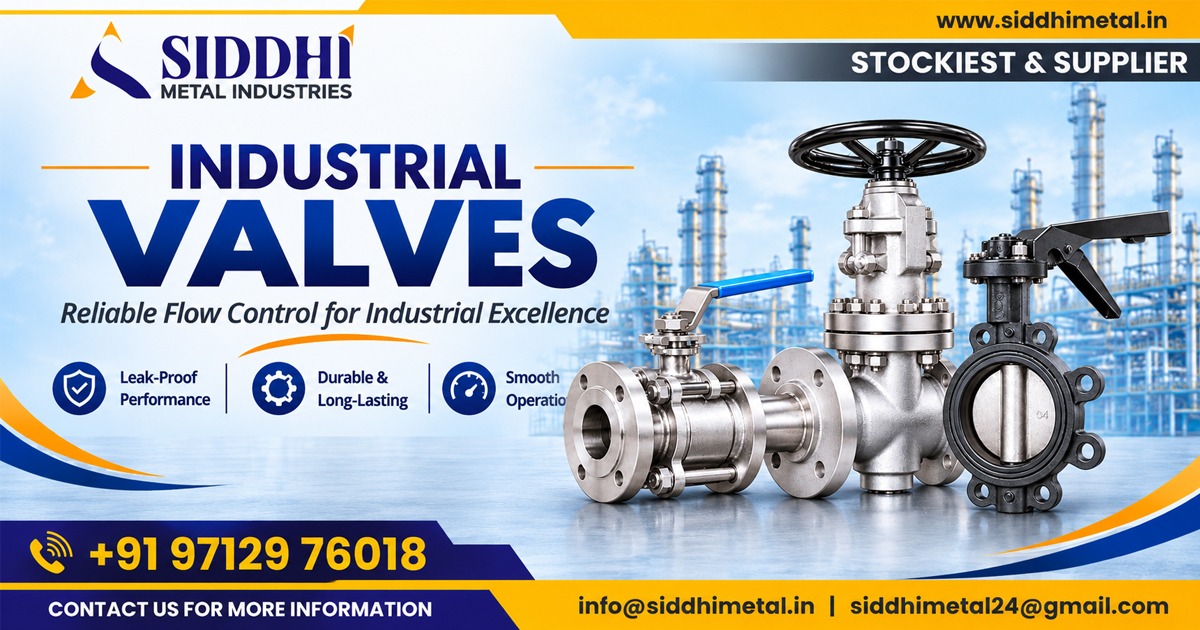
Common valve categories include:
- Ball Valves: Used mainly for quick opening and closing of pipeline flow.
- Gate Valves: Commonly selected for isolation duties where a full-flow passage is required.
- Globe Valves: Used where flow regulation is an important operating requirement.
- Butterfly Valves: Often considered for larger pipeline sizes and space-conscious installations.
- Check Valves: Help prevent reverse flow in suitable pipeline systems.
- Plug Valves: Used for flow isolation and control in compatible services.
The correct choice depends on the actual process duty. A valve designed for simple isolation should not automatically be treated as a precise flow-control device.
2. Match the Valve Design With the Required Process Function
One of the common purchasing challenges is selecting a valve based only on pipeline diameter. Two pipelines may have identical dimensions but require different valve designs because their operating conditions and functions are not the same.
Before selecting Industrial Valves for Process Control and Pipeline Applications, identify what the valve must accomplish.
| Pipeline requirement | Valve type to evaluate |
| Opening and closing flow | Ball or gate valve |
| Flow regulation | Globe or suitable control valve |
| Prevention of reverse flow | Check valve |
| Isolation in larger pipelines | Butterfly valve |
| Isolation in compatible process lines | Plug valve |
For example, a water distribution pipeline may require isolation valves at different sections, while a chemical processing line may need a valve selected according to the chemical composition and operating temperature.
Engineers should also distinguish between on/off operation and continuous flow regulation. The valve’s internal design, operating characteristics, and control arrangement must match the intended function.
3. Material Compatibility Starts With the Process Medium
The valve body is only one part of the material selection decision. Internal components, seats, seals, stems, and other wetted parts must also be suitable for the fluid passing through the pipeline.
Industrial valves may be available in different material configurations, depending on the product design and service conditions.
| Material | Selection consideration |
| Stainless Steel (SS) | Considered for corrosion resistance and applications requiring suitable stainless steel grades |
| Carbon Steel (CS) | Evaluated for strength and compatible pressure-temperature conditions |
| Alloy Steel | Considered for selected demanding temperature and pressure requirements |
Buyers should assess:
- Chemical composition and concentration of the fluid.
- Operating and maximum design temperature.
- Normal and maximum working pressure.
- Possibility of corrosion, erosion, or abrasive particles.
- Compatibility of seats, seals, and internal components.
For example, a valve used in a water line may have different material requirements from one handling corrosive chemicals. Selecting the body material without checking internal components can create avoidable operating problems.
Material selection should therefore be confirmed against the process datasheet and the valve manufacturer’s technical information.
4. Technical Details That Should Be Settled Before Ordering
A suitable valve must match both the pipeline dimensions and the operating requirements. Incorrect sizing or connection selection can create installation difficulties and affect the intended flow performance.
The following details should be included in the purchase enquiry:
Nominal Pipe Size: Confirm the pipeline diameter and required valve size. A matching connection size alone does not establish correct flow capacity.
Pressure Rating: Specify normal operating pressure, maximum design pressure, and any expected pressure variations.
Temperature Range: Provide normal and maximum process temperatures to check the applicable pressure-temperature rating.
End Connection: Confirm whether the pipeline requires flanged, threaded, welded, wafer, or another compatible connection.
Operating Method: Identify whether manual operation is sufficient or pneumatic, hydraulic, or electric actuation is required.
Flow Characteristics: For regulating duties, discuss required flow rate, pressure drop, and control performance.
Installation Dimensions: Check face-to-face dimensions, available space, operating clearance, and accessibility.
These details help procurement teams obtain comparable quotations and reduce confusion between the requested product and the offered configuration.
5. Integrating Valves Into an Existing Pipeline System
Valve installation should be planned as part of the complete piping arrangement rather than as an isolated component purchase.
A typical pipeline installation sequence includes:
1. Review the Pipeline Drawing: Identify the installation position, flow direction, line size, and required valve function.
2. Check Connection Compatibility: Match the valve ends with the existing pipeline connection arrangement.
3. Prepare the Installation Area: Provide sufficient working space for installation, operation, and future inspection.
4. Position the Valve: Follow the manufacturer’s installation instructions and any specified flow-direction markings.
5. Complete the Connections: Ensure that the mating components and joining method are appropriate for the valve design.
6. Conduct Commissioning Checks: Inspect the installation and perform suitable leakage and functional checks according to the approved project procedure.
For automated valves, additional planning may be required for actuator mounting, electrical or pneumatic connections, control signals, and operating access.
Proper coordination between piping engineers, installation teams, and procurement personnel helps avoid last-minute changes at the project site.
6. Inspection and Maintenance Considerations During Plant Operation
Valve maintenance should focus on identifying wear, leakage, operating difficulties, and changes in performance before they interrupt normal plant activities.
A practical inspection routine may include:
- External Leakage: Check around the body joints, flange connections, stem, and sealing areas.
- Operating Movement: Observe whether the valve opens and closes smoothly without unusual resistance.
- Seal Condition: Inspect accessible sealing components for visible wear or deterioration.
- Corrosion Inspection: Examine exposed surfaces for corrosion or damage caused by the operating environment.
- Actuator Checks: For automated valves, inspect actuator connections and operating signals according to manufacturer instructions.
- Spare Parts Planning: Identify replacement seals and other service components required for the installed valve configuration.
Common operating observations can also help maintenance teams identify possible problems.
| Common observation | Possible reason | Practical action |
| Leakage near connections | Incorrect jointing or damaged gasket | Inspect connection and sealing arrangement |
| Difficult operation | Deposits, wear, or mechanical resistance | Arrange suitable inspection |
| Incomplete closing | Seat damage or foreign particles | Check the valve’s internal condition |
| Reverse flow | Check valve malfunction or unsuitable selection | Verify installation and valve operation |
Before inspection or maintenance, isolate the pipeline, release stored pressure, and follow the plant’s approved safety procedures. Internal servicing should be handled by qualified personnel.
7. What Industrial Buyers Should Verify Before Finalising an Order
Purchasing teams should evaluate the complete valve requirement rather than comparing suppliers only through product names and quoted prices.
Use this checklist before confirming an order:
- Valve type and intended operating function.
- Required nominal size and connection dimensions.
- Body, trim, seat, and seal material.
- Operating and design pressure.
- Normal and maximum temperature.
- Flow direction and flow-control requirements.
- Manual or automated operating arrangement.
- Applicable product design and testing requirements.
- Inspection records and material documentation, where required.
- Installation compatibility and maintenance accessibility.
- Availability of suitable replacement components.
- Technical support and project-specific requirements.
A common purchasing mistake is selecting a valve based on the same nominal size as the pipeline without checking its flow characteristics and pressure-temperature rating.
Another mistake is overlooking the difference between isolation and throttling. A valve suitable for shutting off a pipeline may not be suitable for continuous flow regulation.
Sharing the process datasheet, piping drawing, and operating requirements with the supplier helps establish a clearer product specification before procurement.
8. Services
Siddhi Metal Industries supports industrial metal product requirements with relevant product and supply assistance.
1. Industrial Valve Supply: Assistance with industrial valve requirements for suitable pipeline and process applications.
2. Material Selection Assistance: Guidance on evaluating stainless steel and other material requirements according to the intended application.
3. Pipeline Component Sourcing: Support for related industrial requirements involving pipes, flanges, fittings, and other metal components.
4. Project-Based Product Coordination: Assistance with reviewing product sizes, connection requirements, quantities, and procurement specifications.
9. Location
Ahmedabad is an important industrial and engineering supply centre in Gujarat, supporting businesses involved in manufacturing, process industries, infrastructure, and pipeline projects. Industrial valve requirements are relevant across Ahmedabad, Sanand, Changodar, Vatva, Naroda, Odhav, Kathwada, Bavla, Dholka, Gandhinagar, Kalol, Mehsana, Kadi, Vadodara, Savli, Halol, Bharuch, Ankleshwar, Dahej, Surat, Hazira, Vapi, Morbi, and Rajkot.
10. Industrial Product Support From Siddhi Metal Industries
Planning an industrial valve purchase involves more than identifying a suitable product category. Buyers must communicate the pipeline dimensions, process medium, operating conditions, material requirements, and connection details.
Siddhi Metal Industries deals in stainless steel and mild steel industrial products, including pipes, flanges, fittings, sheets, fasteners, and industrial valves. The company can assist buyers with product enquiries and related industrial metal component requirements.
With manufacturing support from Ahmedabad, Gujarat, India, the company serves industrial procurement and project-related requirements. Buyers can explore the product range and company information through the official website: https://siddhimetal.in/.
For project enquiries, sharing the required valve configuration and pipeline specifications helps make product discussions more relevant and practical.
Frequently Asked Questions (FAQs)
Q1. Which industrial valve is suitable for controlling pipeline flow?
A: Globe valves and specially designed control valves are commonly considered for flow regulation. The final selection depends on flow rate, pressure drop, fluid properties, and required control characteristics.
Q2. Can stainless steel valves be used in chemical processing pipelines?
A: Yes, suitable stainless steel grades can be considered for certain chemical services. Compatibility must be checked against the chemical concentration, temperature, and wetted components.
Q3. What information should be provided when requesting an industrial valve quotation?
A: Provide valve type, pipeline size, fluid medium, pressure, temperature, material, end connection, operating method, and required quantity. Project drawings can also help clarify the requirement.
Q4. How can buyers identify whether an existing pipeline valve needs replacement?
A: Persistent leakage, damaged sealing surfaces, difficult operation, corrosion, and failure to achieve the required shut-off can indicate a replacement requirement. A qualified inspection should confirm the cause.
Conclusion
Reliable pipeline operation depends on matching valve design, material, pressure rating, and operating function with actual process conditions. Industrial buyers in Ahmedabad and across Gujarat should finalise these details before procurement. Siddhi Metal Industries offers manufacturing support from Ahmedabad, Gujarat, India, for related industrial product requirements.
Discuss your pipeline and process requirements with Siddhi Metal Industries to explore suitable industrial valve and metal component options.
Email Us:
info@siddhimetal.in | siddhimetal24@gmail.com
Phone Number:
+91 97129 76018